If a person has weakness in the lower fibers of the Rectus abdominis, the pelvis will most often be held in an anteriorly tilted position creating an increased lordosis of the lumbar spine and protruding of the abdomen.
Origin
Insertion
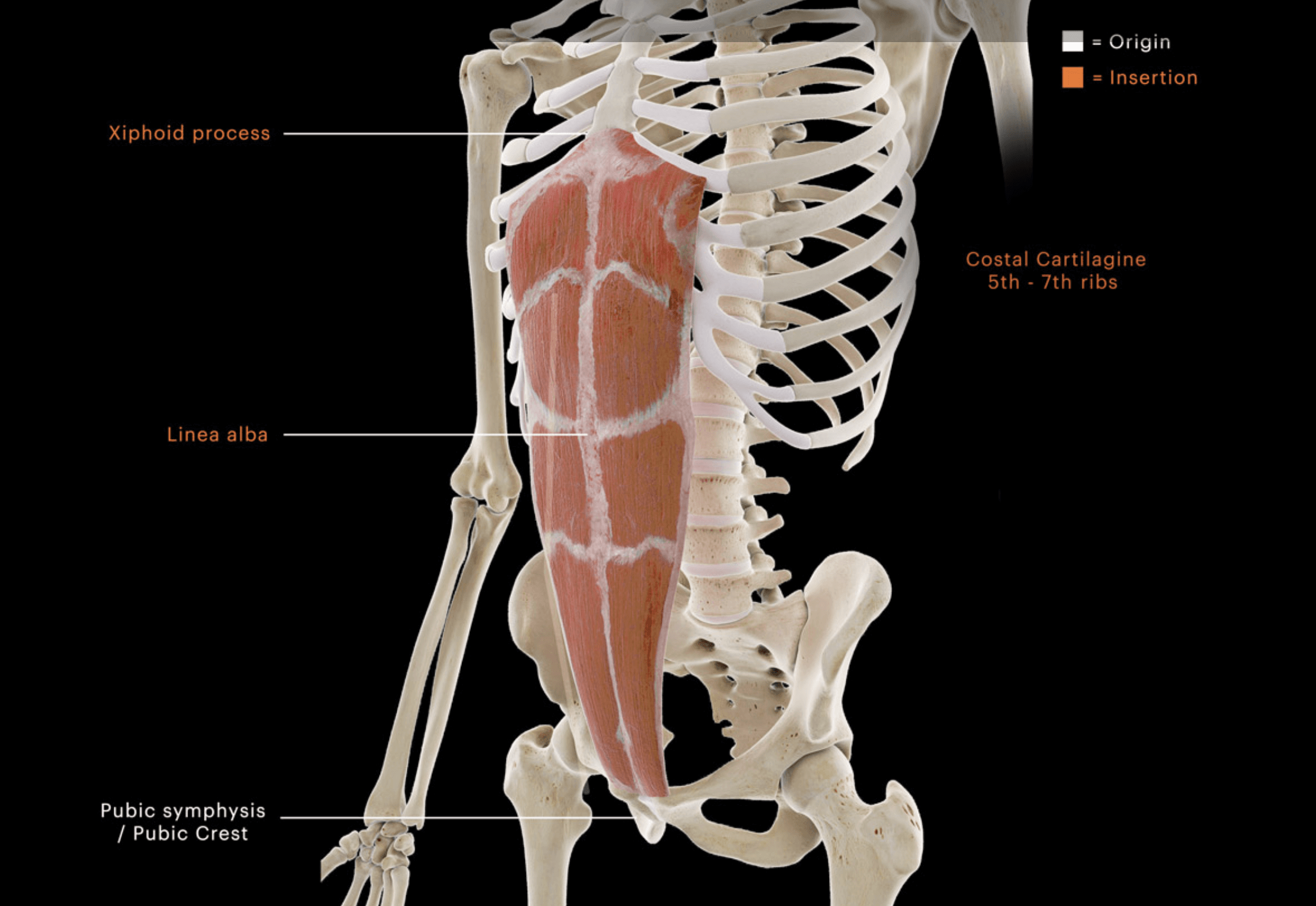
The rectus abdominis is a long muscle that forms together with the pyramidalis muscle the anterior abdominal wall.
Inferiorly the rectus abdominis muscle is attached by two tendons; the larger one is attached to the pubic crest, from the pubic tubercle to the pectineal line, while the small, medial tendon is attached to the pubic symphysis.
The rectus abdominis muscle is a paired muscle that runs vertically, either side of the linea alba, and insert into the xiphoid process of the sternum and costal cartilages of the 5th to the 7th ribs.
In total there are three tendinous intersections in the rectus abdominis muscle. One of these horizontal intersections is present at the level of umbilicus, another at the level of xiphoid process and the third midway between them. These fibrous bands divide the muscle into segments, resulting in a ‘six pack’ shape in those with low body fat.
Although the rectus abdominis is a single muscle, it is innervated by the anterior primary rami of the T7 to T12 spinal nerves. This segmental nerve supply allows each portion of the muscle to contract independently. For instance, by focusing on the part of the rectus abdominis below the belly button and extending to the pubic bone, individuals can specifically target and strengthen the lower segments of the muscle during exercises.
The rectus abdominis muscle, a key component of the anterior abdominal wall, is connected to the linea alba, a fibrous structure that runs down the midline of the abdomen, providing structural support and serving as the attachment point for the abdominal muscles.
On either side of the rectus abdominis, the pyramidalis muscle lies, a small triangular muscle that helps to tense the linea alba. Together, the rectus abdominis, linea alba, and pyramidalis work to stabilize the core and assist in movements such as flexion and rotation of the trunk.
Origin
Pubic symphysis, pubic crest
Insertion
Linea alba
Function
Tenses the linea alba.
Origin
Tip of the xiphoid process
Insertion
Anterior fibres: pubic symphysis,
Posterior fibres: pubic crests on both sides.
EXPLANATION
The linea alba isa fibrous structure that divides the two halves of the rectus abdominis muscle vertically on the midline of the abdomen.
The aponeuroses of the internal and external oblique abdominal muscles and the transversus abdominis muscle extend vertically across the anterior aspect of the abdomen. While crossing over to the opposite side, their aponeurotic fibers interweave along the midline of the abdomen, forming the thickening of the linea alba.
The linea alba generally lacks blood supply and innervation. Due to this, it is a common incision during abdominal surgery.
The umbilicus is located slightly inferior to the midpoint of the Linea alba, the linea alba is widest around the umbilicus. Its width and thickness also vary depending on one’s weight, age and sex.
ClLINICAL CORRELATION
The rectus abdominis diastasis, is defined as a gap of 2.7 cm or greater between the two sides of the rectus abdominis muscle. The distance between the right and left rectus abdominis muscle is created by the stretching of the linea alba. Diastasis of the rectus abdominis muscle most frequently occurs in newborns and pregnant women. In the newborn, the rectus abdominis muscle is not fully developed and may not be sealed together at midline (this is especially true for premature newborns).
The increasing weight during pregnancy combined with hormonal changes and altered posture can increase the load on the abdominal wall and result in the stretching of the linea alba. This linea alba stretching can also be attributed to excessive abdominal exercises after the first trimester of pregnancy.
In this case, a program of specific corrective Core exercises may help to reduce the size of the gap in pregnant or postpartum women. In extreme cases, diastasis is corrected with a cosmetic surgery procedure known as abdominoplasty.
Trunk Flexion
Trunk Lateral Flexion (Ipsilateral)
Trunk Rotation (Ipsilateral)
Postural Support
Intra-Abdominal Pressure Regulation
Pelvic Stabilization
Assistance in Breathing
Support During Childbirth
Act as Antagonist to the Diaphragm
The Core Structure & Function
Mentor Exercise Review
A Mentor Review is a live guided session where you can present exercises, ask questions, and receive individual feedback on your execution, cueing, and reasoning.
Please prepare (at least) one exercise you would like feedback on. Active participation is encouraged to gain the full benefit of the session.
Sessions require a minimum of two participants. If fewer than two students are registered 48 hours in advance, the session will be cancelled.
Mentor Reviews are scheduled based on participant availability. You will receive a confirmation email once your session is finalized.
©KINETICODE® 2025. ALL RIGHTS RESERVED
The Spine & Neck – Back Muscles Lectures – Part 2
©KINETICODE® 2026. ALL RIGHTS RESERVED
The Spine & Neck – Back Muscles Lectures – Part 1
©KINETICODE® 2026. ALL RIGHTS RESERVED
The Pelvis & Posterior Abdominal Wall Lectures –
Part 2
©KINETICODE® 2026. ALL RIGHTS RESERVED
The Pelvis & Posterior Abdominal Wall Lectures –
Part 1
©KINETICODE® 2026. ALL RIGHTS RESERVED
The Core Structure & Function Lectures – Part 2
©KINETICODE® 2026. ALL RIGHTS RESERVED
The Core Structure & Function Lectures – Part 1
©KINETICODE® 2026. ALL RIGHTS RESERVED
©KINETICODE® 2026. ALL RIGHTS RESERVED
Price of the Course: €2.500
(excl. VAT, reclaimable)
*Prefer a payment plan? Email us at academy@kcmove.nl with a proposal.
Invest in your future as a Pilates professional with Europe-wide recognized certification. This fee gives you full access to a carefully designed 7-month learning journey that blends science, practice, and mentorship.
Your investment includes:
©KINETICODE® 2026. ALL RIGHTS RESERVED
The KinetiCode® Pilates Certification follows a 7-month study cycle, designed for maximum flexibility. You can begin at the start of any month and progress at your own pace while completing all required coursework.
In total, the course includes:
Total course time = 250 hours
©KINETICODE® 2026. ALL RIGHTS RESERVED
This website uses cookies to enhance your experience. Some are essential for site functionality, while others help us analyze and improve your usage experience. Please review your options and make your choice.
If you are under 16 years old, please ensure that you have received consent from your parent or guardian for any non-essential cookies.
Your privacy is important to us. You can adjust your cookie settings at any time. For more information about how we use data, please read our privacy policy. You may change your preferences at any time by clicking on the settings button below.
Note that if you choose to disable some types of cookies, it may impact your experience of the site and the services we are able to offer.
Some required resources have been blocked, which can affect third-party services and may cause the site to not function properly.